The Women of “Tewa Nangeh/Tewa Country”: Charine Pilar Gonzales, Marita Swazo Hinds, Eliza Naranjo Morse, and Martha Romero
Celebrating International Women’s Day with the Georgia O’Keeffe Museum
In recognition of International Women’s Day and Women’s History Month, the Georgia O’Keeffe Museum is sharing stories about women who have made lasting contributions to the art world. Jaune Quick-to-See Smith (citizen of the Confederated Salish and Kootenai Nation) was the first Indigenous woman to have work exhibited at the Museum in 2012, but the trailblazing artist wasn’t the last. Meet the four women currently making history at the O’Keeffe Museum: Charine Pilar Gonzales, Marita Swazo Hinds, Eliza Naranjo Morse, and Martha Romero.
This is the second wave of indigenous women celebrated in the Museum Galleries, with their work a part of Tewa Nangeh/Tewa Country, an exhibition that brings O’Keeffe’s art and personal objects into dialogue with newly created artworks by contemporary Tewa artists to highlight themes of sacred spaces, belonging, identity, and ownership.
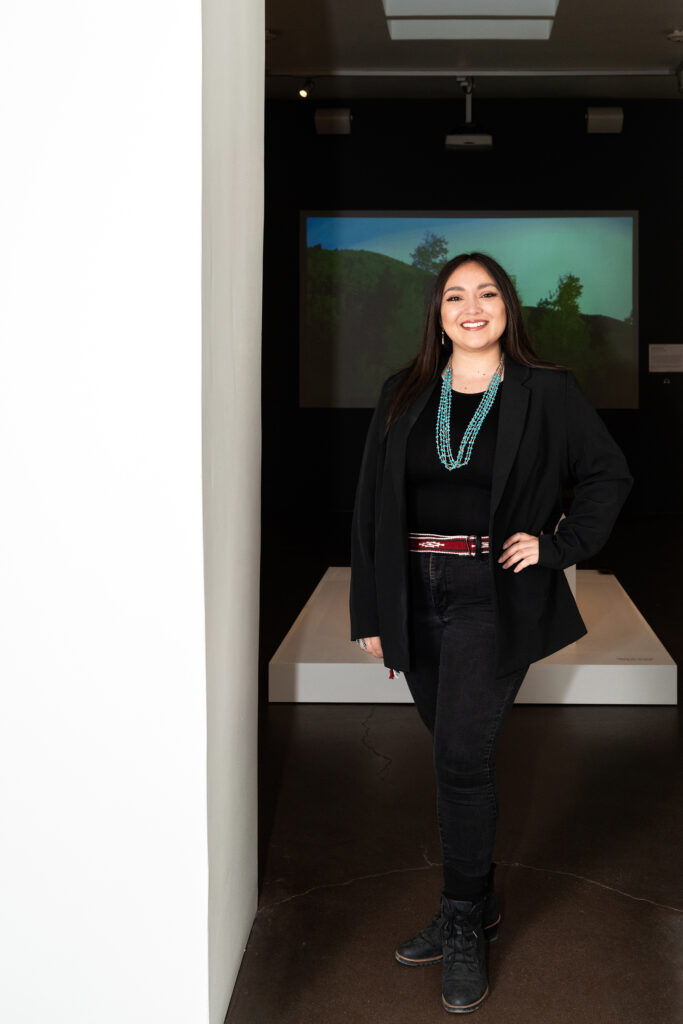
Charine Pilar Gonzales (San Ildefonso Pueblo)
Charine Pilar Gonzales “Ku’yan Povi/Turquoise Flower” is a Tewa filmmaker from San Ildefonso Pueblo and Santa Fe, New Mexico. Her documentary Our Quiyo: Maria Martinez (2022) premiered at the John F. Kennedy Center for the Performing Arts and was followed by River Bank (Pō-Kehgeh). She co-produced the Sundance-premiered short documentary Winding Path (2024), serves as associate producer on the People of the West series, and produces for the Native Lens project. Gonzales is the owner of Povi Studios.
Gonzales holds a BFA in Cinematic Arts from the Institute of American Indian Arts and a BA in English Communication from Fort Lewis College. A 2024 Native Lab Fellow with the Sundance Institute Indigenous Program, she is currently enrolled in IAIA’s MFACW Screenwriting program. Additional fellowships include the First Peoples Fund and the Jackson Wild Summit. She lives in Santa Fe with her family.
For Tewa Nangeh/Tewa Country, Gonzales directed and produced two videos: one portraying the artists in their studios and another featuring her family and elders titled This Land Carries Us. The film focuses on the artists and offers glimpses into their creative worlds while presenting an intimate view of contemporary Pueblo life.
This Land Carries Us centers Tewa presence, voice, and memory on ancestral lands through site-specific footage and family narratives. The film’s visuals affirm the inseparability of Tewa lands and Tewa people.
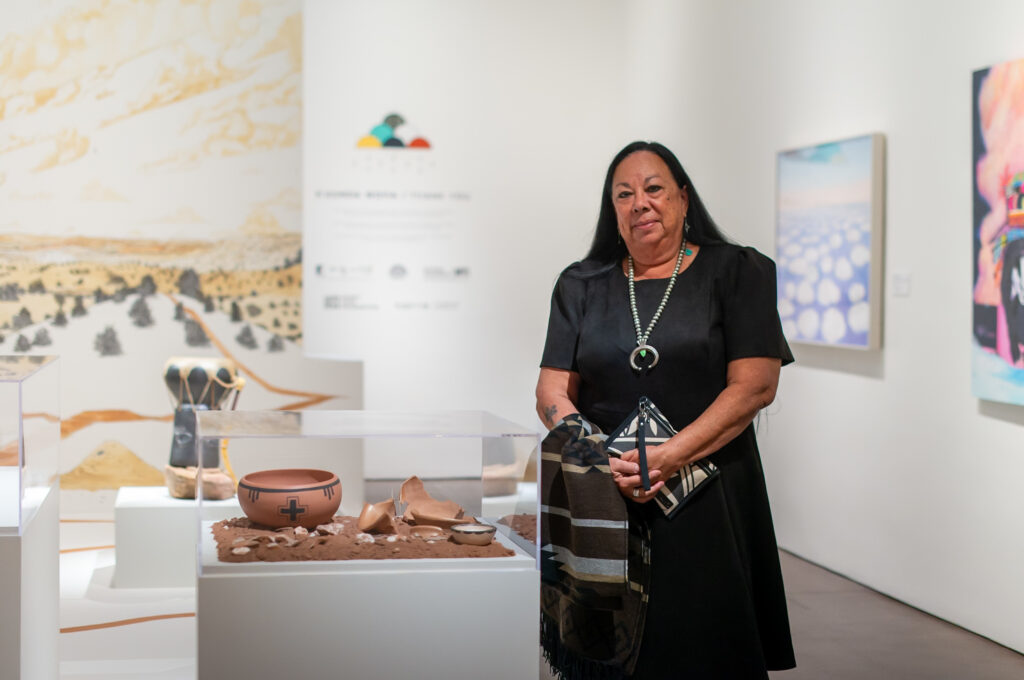
Marita Swazo Hinds (Tesuque Pueblo)
Marita Swazo Hinds is a Tesuque Pueblo potter who works with micaceous, hand-gathered clay and has employed traditional outdoor firing techniques for more than a decade. She has studied at the Poeh Cultural Center under instructors including Shawn Tafoya, Michael Bancroft, and Eric Fender. In 2024, she received a grant supporting the revitalization of Tesuque pottery traditions.
Hinds contributed to the curatorial collective for Grounded in Clay: The Spirit of Pueblo Pottery, exhibited at the Museum of Indian Arts and Culture, the Metropolitan Museum of Art, and the Museum of Fine Arts, Houston. She emphasizes sustaining cultural traditions and mentoring tribal potters, and currently works in education at the Museum of Indian Arts and Culture.
Inspired by O’Keeffe’s teapot collection, Hinds created Let’s Have Tea, Tea Time With Georgia (2025). While shaping the teapot, cups, and saucers, she imagined sharing tea with O’Keeffe and reflected on questions about conversation, ritual, and creative exchange. She also created Did Georgia Pray? (2025), a display incorporating pot sherds, earth, and rocks gathered from Ghost Ranch. Through this work, Hinds reflects on her creative process and considers parallels with O’Keeffe’s practice, posing questions about land stewardship and spiritual connection.
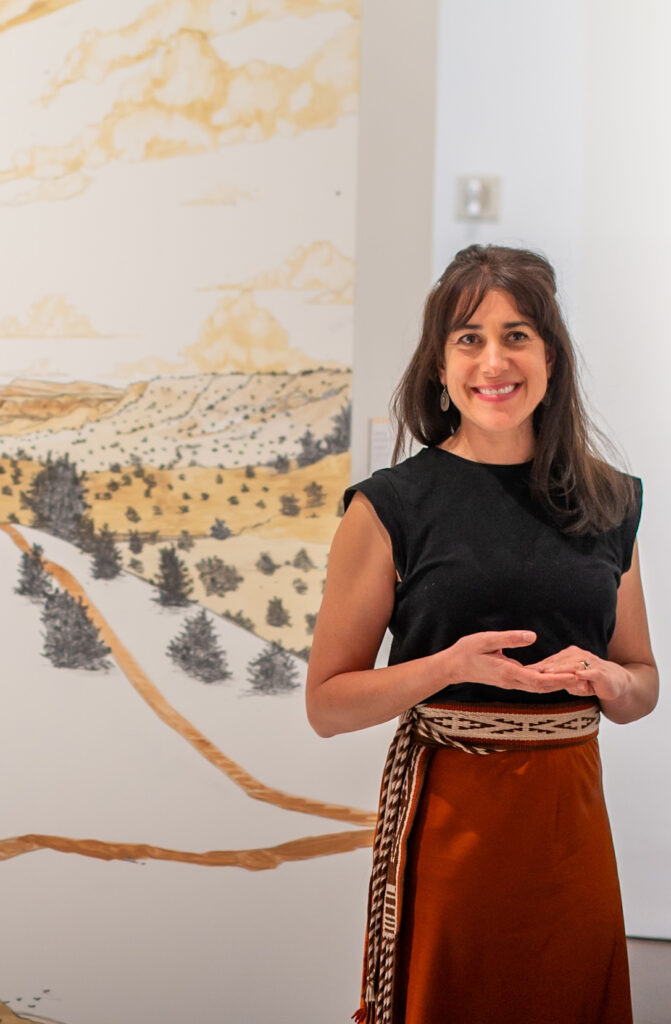
Eliza Naranjo Morse (Kha’p’o Owingeh/Santa Clara Pueblo)
Eliza Naranjo Morse is a multidisciplinary artist working across painting, sculpture, land-based art, and institutional collaboration. She has partnered with organizations including the National Museum of Women in the Arts, the National Museum of the American Indian, and the Museum of Contemporary Native Art. As Cultural Arts Teacher at Kha’p’o Community School, Morse integrates land-based art into curricula to strengthen students’ environmental relationships. A graduate of Skidmore College, she continues to develop artistic, educational, and ecological work exploring humanity’s relationship with the universe through knowledge sharing.
For the exhibition, Morse created Coming Home (2025), a mural composed of pencil, hand-gathered clay, and natural pigments that anchors the largest gallery. The work reflects on Tewa Country and honors the individuals who care for it, acknowledging ongoing acts that sustain relationships with the land, preserve the Tewa language, and uphold values of respect and reciprocity.
Morse also encourages audiences to learn from organizations engaged in Tewa communities, including Honor our Pueblo Existence, the Traditional Native American Farmers Association, Tewa Women United, and Flowering Tree Permaculture Institute. Two additional paintings by Morse, A Story of Stardust, Part 2 (2025) and A Prayer Making Its Way (2024), are presented in the same gallery.
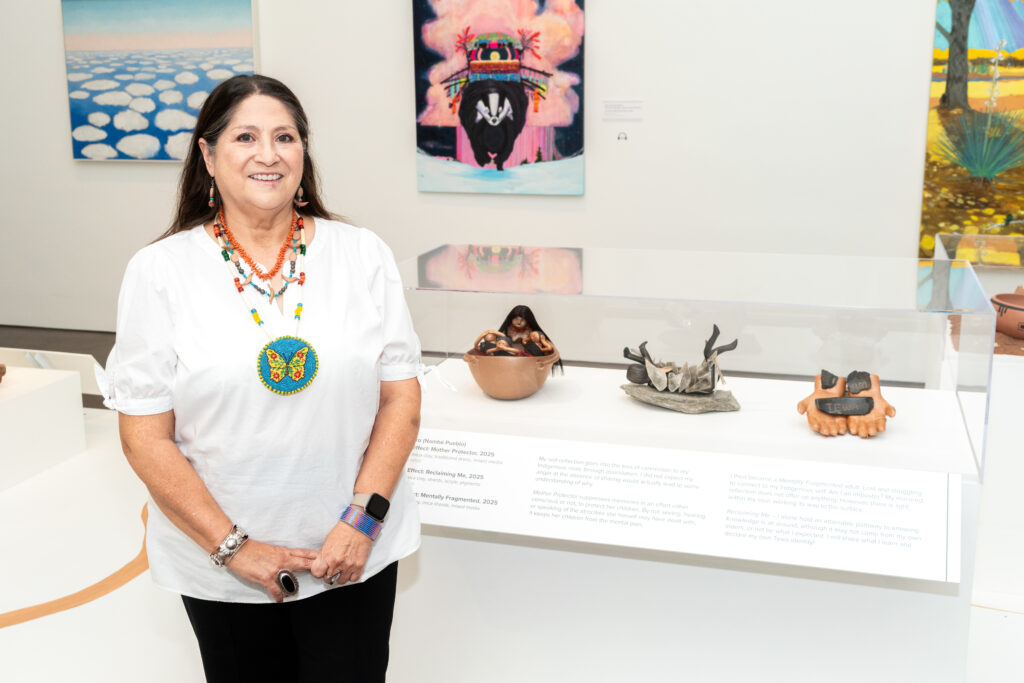
Martha Romero (Pueblo of Nambé)
Martha Romero “Kwahtenbay/Rainbow” is a potter from the Pueblo of Nambé whose artistic path was shaped by her mother, Rose Alice Garcia-Baca, and teachings surrounding mother clay. Romero studied with pottery masters Clarence Cruz, Pamela Lujan-Hauer, and Michael Bancroft through the Poeh Cultural Center. She prioritizes working with tribal members—including youth—to sustain traditional pottery practices and mentors artists within Nambé Pueblo.
Romero has also provided micaceous pottery instruction for the School of Advanced Research and Ghost Ranch. Her work highlights pottery’s utilitarian role, often demonstrated through cooking and care practices for functional vessels such as bean pots.
She participated in the Pueblo Pottery Collective for Grounded in Clay: The Spirit of Pueblo Pottery, organized by the School of Advanced Research and the Vilcek Foundation. Romero received a Congressional Record from Michelle Lujan Grisham in recognition of her artistic contributions and has exhibited work at SWAIA events, the Poeh Cultural Center, the Museum of Indian Arts and Culture, and the Heard Museum Guild Indian Fair & Market.
In Tewa Nangeh/Tewa Country, Romero created moving clay pieces that portray her experience as a Tewa person and her response to O’Keeffe as an artist. In Assimilation Effect: Reclaiming Me, 2025, she takes the viewer on her life journey through three clay sculptures titled Mother Protector, Mentally Fragmented, and Reclaiming Me. She says her self-reflection dives into the loss of connection to her Indigenous roots through assimilation and found that her anger at the absence of sharing Tewa culture actually led to some understanding of why.
She also created a drum from mica clay—an uncommon material for a drum, rawhide, and sinew. After asking the clay what it wanted to be, Romero was struck by how clearly the answer was “a drum.” Sounds of the drum being plated Hugo Lopez, Pueblo of Pojoaque, can be heard in the exhibition.
—
Tewa Nangeh/Tewa Country is on view through the fall of 2026. Admission for the Georgia O’Keeffe Museum is free for members of Indigenous communities, tribes, and nations for the duration of Tewa Nangeh/Tewa Country.