
A Scholar’s Mark on the Art World: Barbara Buhler Lynes and O’Keeffe’s Catalogue Raisonné
Celebrating Women’s History Month with the Georgia O’Keeffe Museum
In recognition of Women’s History Month, the Georgia O’Keeffe Museum is sharing stories about women who have left their mark on the art world. While O’Keeffe has fascinated audiences for nearly a century, some of that fascination would arguably not be possible without Barbara Buhler Lynes. The founding curator of the Georgia O’Keeffe Museum and the preeminent O’Keeffe scholar, Lynes is the author of O’Keeffe’s original catalogue raisonné, a detailed and comprehensive record of all known works from the artist’s decades-long career.
When first published in 1999, the two-volume set established a new standard for accuracy and scholarship surrounding O’Keeffe’s work in all media, including sketches, works on paper, pastels, oil paintings, ceramics, and sculpture.
Now, that work is being transformed for the 21st century with the launch of Access O’Keeffe, a digital catalogue raisonné debuting this month. On the verge of yet another groundbreaking project in the art world, the Museum sat down with Lynes to reflect on her extraordinary achievements.
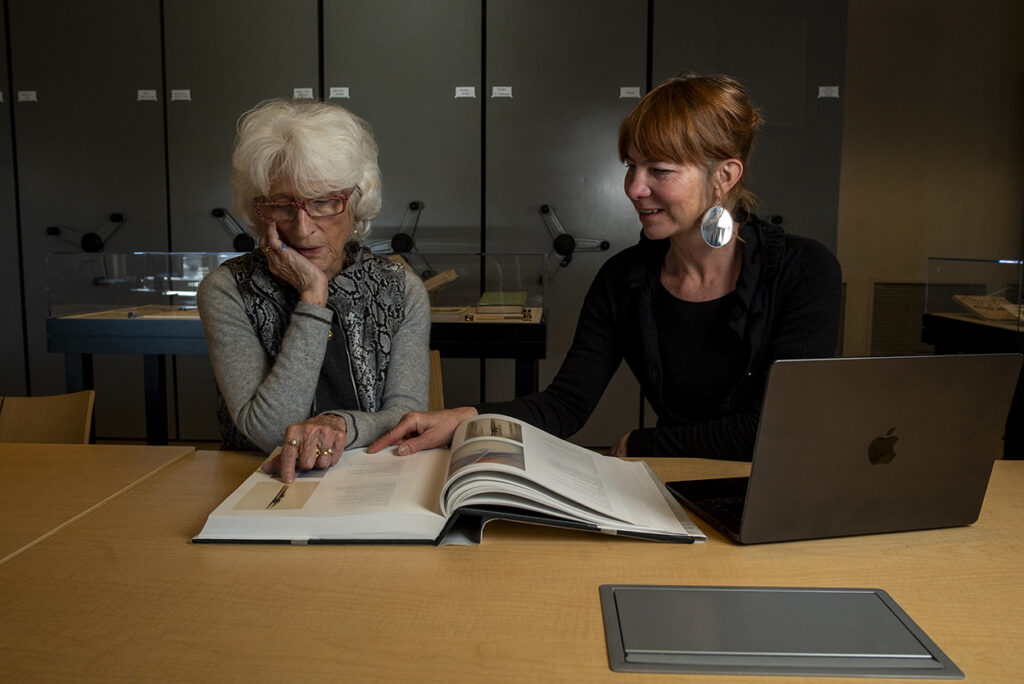
Can you give us an overview of the process of creating the original catalogue raisonné? What do you remember about the project?
The whole project was to document the entirety of O’Keeffe’s work for the first time—all of it. That included tracking down all the former and current owners of Georgia O’Keeffe’s work and seeing it in person. At that time, there were so many reproductions or copies, and photographs at the time couldn’t show you brush strokes or things like that. So, we had to see it all.
I first came to Santa Fe because, at the time she died, O’Keeffe owned half of her output. Once she passed, the Georgia O’Keeffe Foundation (which is now dissolved) took ownership of a significant portion of those works. Through her records, we were able to find some current owners, but I had to track down sales records.
We began by looking at sales records at the Downtown Gallery of the Archives of American Art, which we were able to get unsealed, the (Doris) Bry records, records of sales from Juan Hamilton and the Abiquiú Notebooks, which was the name of O’Keeffe’s copy of the Whitney Archive, a written record of everything she produced that was stored in her Home & Studio. In Abiquiú, we also found a number of drawings and works on paper she had never recorded and a major oil painting in her salita (storage room) which she thought was lost. Once I knew who had bought and sold pieces, I began visiting all the owners, which were institutional and private collectors.
I started with and had tremendous cooperation from Museums around the country. They would unframe and take the backings off of pictures to see the materials that O’Keeffe used consistently, the way she signed the works, and her inscriptions. We learned that for O’Keeffe, the verso was often as important as the front of the paintings. Then I started to visit private collectors when I was in the same city or region as Museums with O’Keeffe’s in their collections.
I managed to document 2029 works. It involved a huge amount of traveling and a huge amount of record-keeping and organization.
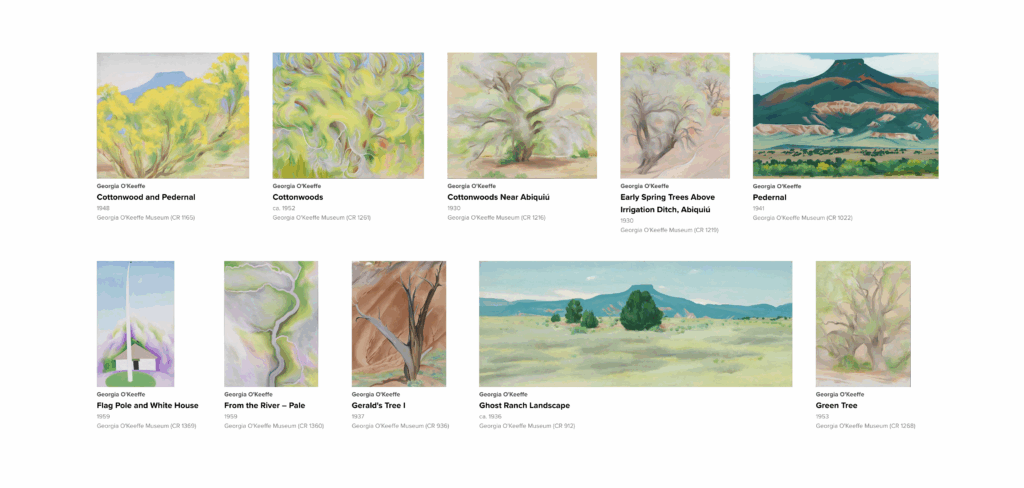
What is it like to see your work turned into a digital platform?
It’s very exciting because not only can we update the records, but it also makes it a living document. The advances that have been made in technology since the 1990’s have been huge. It is phenomenal to be able to create a way for all of the records and research available online. It really is incredible.
The whole point of the original catalogue raisonné was to make it accurate. Now, it’s about making that research accessible.
Access O’Keeffe allows for your initial research to grow for many years to come, even generations to come. How does it feel to know you have played such a significant role not just in O’Keeffe’s legacy but in art history?
I’ve always felt that I just did a job. The interest in O’Keeffe has maintained itself. More and more people are becoming aware of how innovative and how important she was as an American artist because her work is so distinctive. You can see through her work that she never followed anyone’s lead, she was always leading.
I’ve seen more O’Keeffe works than anyone other than Georgia O’Keeffe and she still interests me. I find out new things about her all the time, and I’m thrilled other people can do the same.
There was no way to anticipate what the catalogue raisonné would become. After all the work, the challenges, and everything I learned, if I were asked to do it again, I would say, “Yes!”
Access O’Keeffe, the digital platform created based on Lynes original catalogue raisonné, is now available to use at access-ok.gokm.org
Related Insights
-
Insight
A Scholar’s Mark on the Art World: Barbara Buhler Lynes and O’Keeffe’s Catalogue Raisonné
March 7, 2026
-

Insight
Mornings with O’Keeffe | How Composer Victoria Bond Found Inspiration in O’Keeffe’s Paintings
February 19, 2026
-

Insight
Mornings with O’Keeffe | ‘Tewa Nangeh/Tewa Country’
January 15, 2026